
If you are searching for ADHD diagnosis Karachi, you may be looking for a psychiatrist or qualified mental health professional who can assess problems such as poor concentration, forgetfulness, impulsive behavior, restlessness, difficulty organizing tasks, or problems managing daily responsibilities.
ADHD, or attention deficit hyperactivity disorder, is a neurodevelopmental condition that can affect children, teenagers, and adults.
A proper diagnosis requires more than simply noticing a few symptoms; a clinician needs to assess symptoms, their history, their impact on daily life, and other possible explanations.
For people in Karachi, the next step is usually to arrange a professional psychiatric assessment.
Dr. Muhammad Ilyas Jat is listed by Dow University of Health Sciences as an Assistant Professor of Psychiatry, with MBBS and FCPS qualifications. His official website also identifies him as a psychiatrist providing adult mental health care in Karachi.
This guide explains what ADHD is, what an assessment involves, how ADHD symptoms can appear in children and adults, what to prepare before an appointment, and what questions you may want to ask a psychiatrist.
What Is ADHD?
ADHD is a neurodevelopmental condition associated with persistent difficulties involving attention, hyperactivity, and impulsivity.
Some people mainly experience problems with attention, while others have prominent hyperactive or impulsive symptoms. ADHD can affect school, work, relationships, organization, and everyday responsibilities.
ADHD is not simply the result of being lazy, careless, or occasionally distracted.
Everyone loses focus or forgets things from time to time. For ADHD to be considered, a clinician looks at the overall pattern of symptoms and whether they cause meaningful difficulties in a person’s life.
ADHD can be recognized during childhood, but some people are not assessed until adolescence or adulthood.
Symptoms may also be overlooked when difficulties are less obvious or when a person has developed ways to compensate for them.
NICE notes that ADHD can continue to affect people throughout their lives and may sometimes be missed, including in girls and women.
What Are the Common Symptoms of ADHD?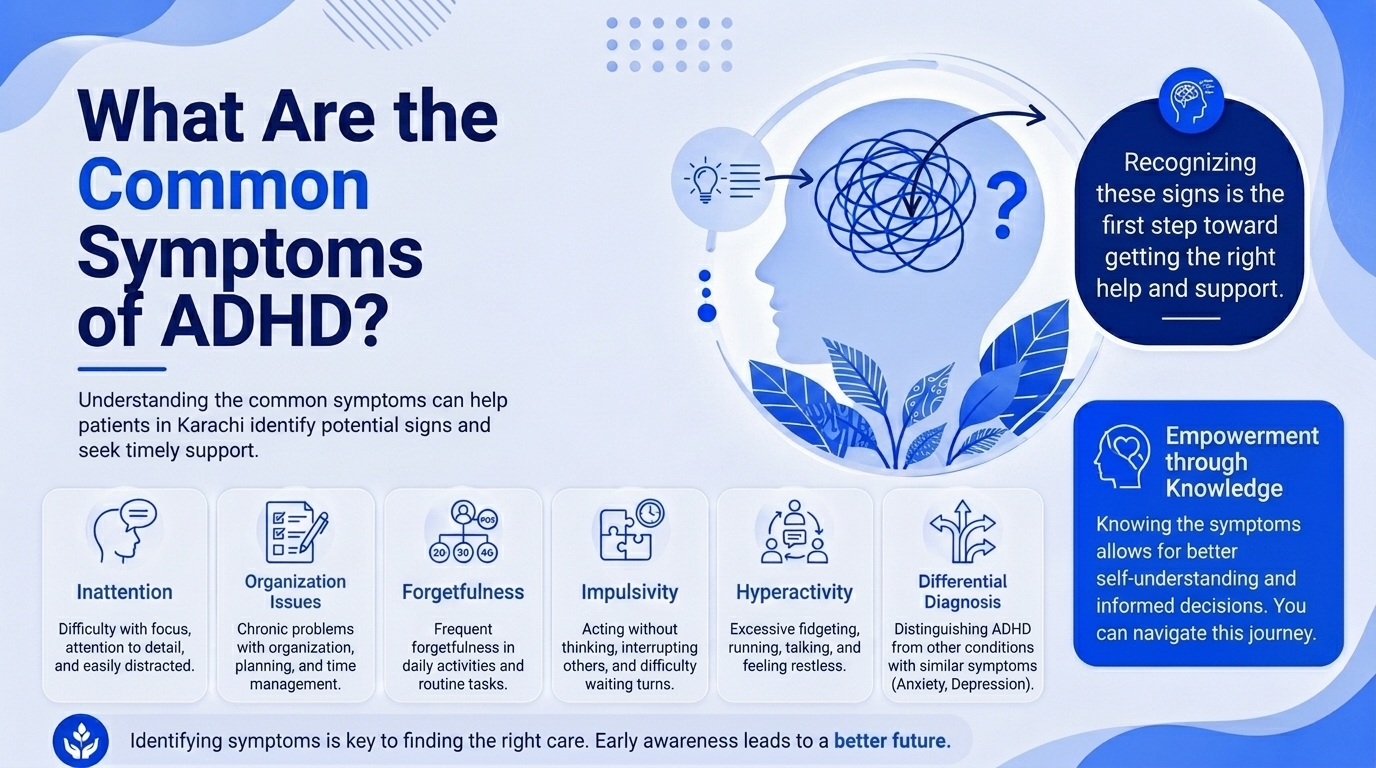
ADHD symptoms are generally considered in two broad areas: inattention and hyperactivity or impulsivity.
A person with significant inattention may frequently have difficulty maintaining focus, organizing activities, remembering everyday tasks, following through on instructions, or completing work that requires sustained mental effort.
Hyperactive or impulsive symptoms can include excessive restlessness, difficulty remaining still, talking excessively, interrupting others, acting without considering consequences, or finding it difficult to wait.
The presence of one or two of these behaviors does not automatically mean someone has ADHD.
The symptoms need to be assessed in context, including their duration, severity, developmental history, and effect on functioning.
ADHD symptoms in children
Parents may notice behaviors such as:
- Difficulty staying focused on schoolwork or instructions
- Frequently losing school supplies or personal belongings
- Forgetting routine tasks
- Excessive movement or restlessness
- Interrupting conversations
- Difficulty waiting for a turn
- Problems completing assignments despite knowing how to do them
Teachers can also provide useful information because a child’s behavior may look different at school and at home.
ADHD symptoms in adults
Adults may experience ADHD differently from young children. Common concerns include difficulty organizing work, missing deadlines, forgetting appointments, losing important items, procrastinating on demanding tasks, struggling to maintain attention during meetings, or acting impulsively.
For an adult assessment, it is useful to consider whether similar difficulties were present earlier in life.
A current concentration problem can have many possible causes, so an adult should not assume that every attention problem represents ADHD.
How Is ADHD Diagnosed?
What happens during an ADHD assessment?
An ADHD diagnosis is based on a clinical evaluation rather than a single blood test, brain scan, or quick online quiz.
A specialist assessment may include a detailed discussion of symptoms, developmental history, medical and mental health history, functioning at school or work, and information from people who know the patient well.
Standardized rating scales may also be used as part of the assessment.
The clinician may ask questions such as:
- When did the difficulties begin?
- How often do they occur?
- Do they happen in more than one setting?
- Do they interfere with school, work, relationships, or daily responsibilities?
- Were similar problems present during childhood?
- Are there other mental or physical health issues that could explain the symptoms?
- Are there sleep, stress, substance use, medication, or environmental factors affecting concentration?
This detailed process helps distinguish ADHD from other conditions that can produce similar difficulties.
Why Is a Professional Evaluation Important?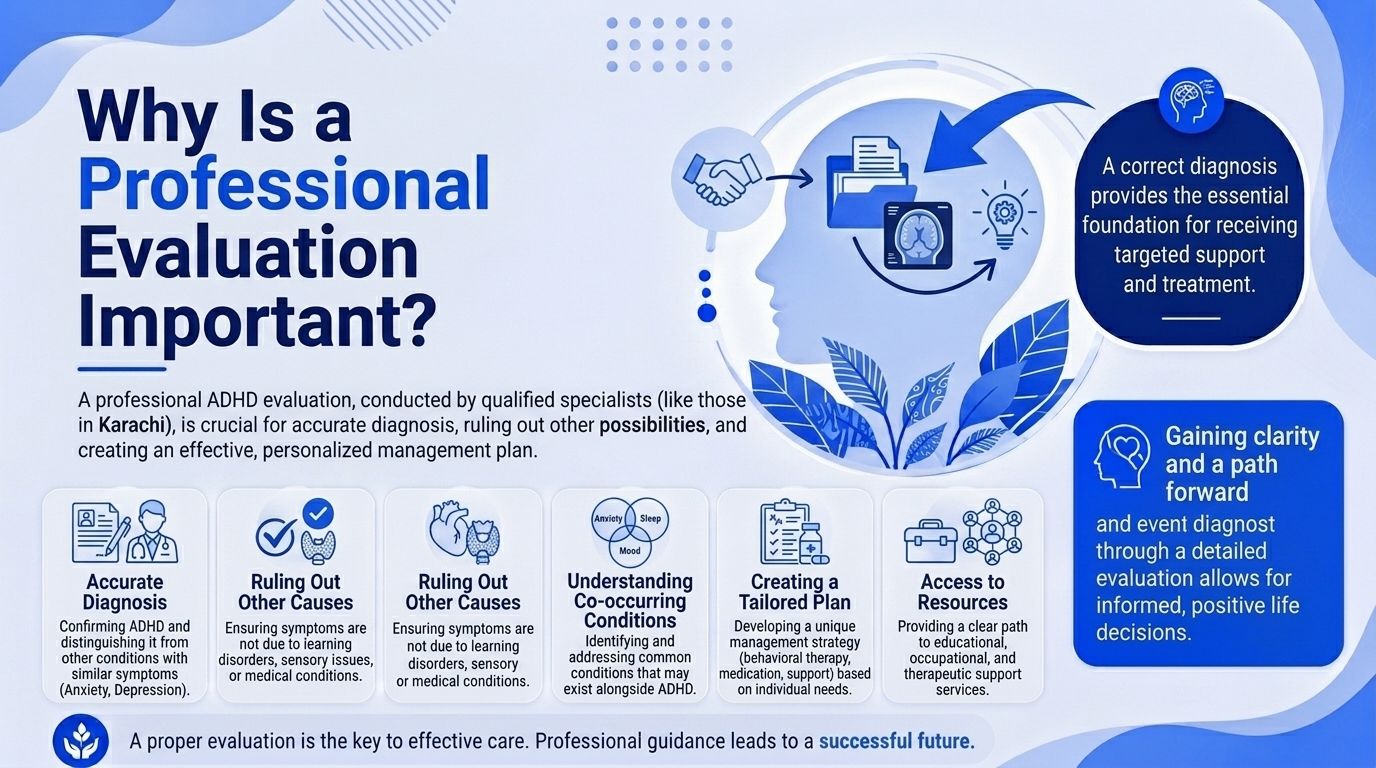
Difficulty concentrating can occur for many reasons. Stress, inadequate sleep, anxiety, depression, certain medical problems, substance use, medication effects, and other mental health conditions can affect attention and everyday functioning.
ADHD can also occur alongside other conditions. NICE guidance recommends considering coexisting conditions and the person’s wider psychological, social, educational, occupational, and physical health needs during assessment.
For this reason, an online ADHD questionnaire can sometimes help a person recognize that professional evaluation may be worthwhile, but it should not be treated as a definitive diagnosis.
ADHD Assessment for Children vs Adults
The general principles of assessment are similar, but the information available to the clinician can differ according to age.
|
Assessment factor |
Children and teenagers |
Adults |
|
Main information sources |
Child, parents or caregivers, teachers |
Adult patient and, where useful, people who know them |
|
School or work information |
School behavior and academic functioning can be important |
Workplace performance and organization may be relevant |
|
Developmental history |
Parents and school records may help |
Childhood history may require careful recall or records |
|
Daily functioning |
Home, school and social settings |
Work, home, relationships and responsibilities |
|
Other conditions |
Learning, behavioral and developmental concerns may be assessed |
Anxiety, depression, sleep and other mental health concerns may be considered |
|
Diagnostic process |
Clinical interview and appropriate assessment tools |
Clinical interview, history and appropriate assessment tools |
The key point is that ADHD assessment is broader than checking whether a person has trouble paying attention. A specialist considers the pattern across the person’s life and the degree of impairment.
What Should You Take to an ADHD Appointment in Karachi?
A little preparation can make the appointment more productive.
Before visiting a psychiatrist, write down the main problems you have noticed and examples of how they affect everyday life.
For a child, parents can collect relevant school observations, report cards, teacher comments, or examples of behavioral difficulties when available.
For an adult, it may help to write down problems involving work, studies, finances, relationships, time management, organization, or household responsibilities.
Also prepare a list of current medications and relevant medical or mental health history.
If you have previously received psychological or psychiatric treatment, bringing available records can give the clinician additional context.
What Questions Should You Ask a Psychiatrist?
You do not need to know the medical terminology before your appointment. Clear questions can help you understand the evaluation process.
Consider asking:
- Do my symptoms require an ADHD assessment?
- What information will you need about my childhood or development?
- Could another condition be causing these symptoms?
- Will you assess anxiety, depression, sleep problems, or other possible causes?
- What happens after the assessment if ADHD is diagnosed?
- What treatment or support options might be considered?
- What should I do if the assessment does not indicate ADHD?
A good evaluation should give you a clearer picture of what is contributing to your difficulties rather than simply assigning a label.
Finding ADHD Evaluation in Karachi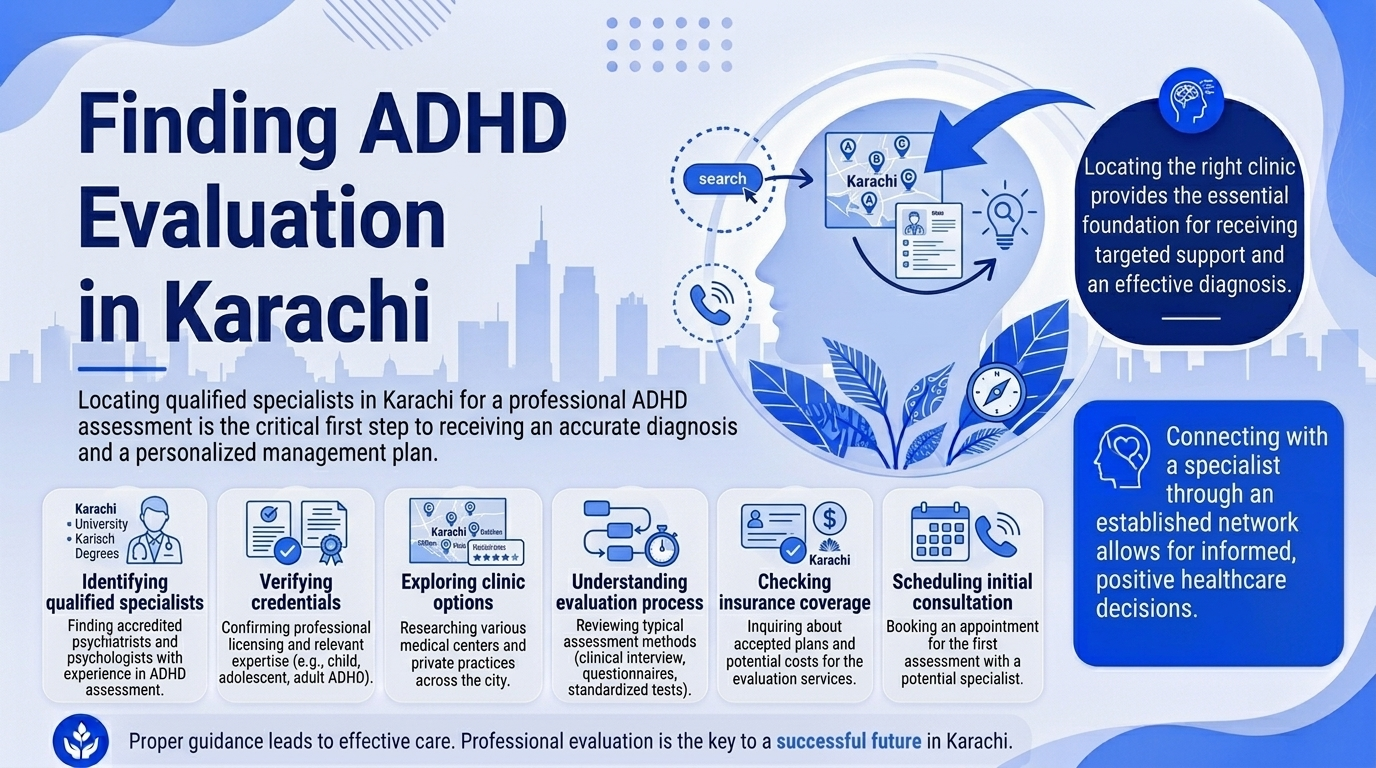
When looking for an ADHD assessment in Karachi, focus on the qualifications and clinical role of the professional rather than relying only on claims such as “best ADHD doctor” or “number one psychiatrist.”
Check whether the clinician has appropriate psychiatric or mental health qualifications, whether they assess patients in your age group, and whether they can evaluate other conditions that may resemble ADHD.
Dr. Muhammad Ilyas Jat is listed by Dow University of Health Sciences as an Assistant Professor of Psychiatry.
The university lists his qualifications as MBBS and FCPS and identifies his workplace as the Dr. A.Q. Khan Institute of Behavioral Sciences.
His official website provides information about his psychiatric services in Karachi, including adult psychiatry.
If you are specifically seeking an ADHD assessment, it is sensible to confirm with the clinic whether ADHD evaluation is currently offered for your age group before scheduling an appointment.
This is especially relevant because the assessment process can differ between children and adults.
What Happens After an ADHD Diagnosis?
A diagnosis is not the end of the process. If ADHD is identified, the clinician can discuss appropriate management according to the person’s symptoms, age, health history, preferences, and daily needs.
Treatment and support can involve different approaches. Depending on the individual, these may include education about ADHD, behavioral strategies, psychological support, environmental changes, skills for organization and time management, and medication when clinically appropriate.
Treatment should be individualized. A medication or approach that is suitable for one person may not be appropriate for another, so treatment decisions should be made with a qualified healthcare professional.
For children, parents, teachers, and healthcare professionals may need to work together to address difficulties at school and home.
Clinical guidelines emphasize assessment and management of coexisting conditions as part of appropriate ADHD care.
Common Mistakes to Avoid When Seeking ADHD Diagnosis
A common mistake is assuming that poor concentration automatically means ADHD.
Attention problems can have multiple causes, so a professional assessment is more useful than self-diagnosis.
Another mistake is relying entirely on social media videos or online quizzes. These resources can help people learn about symptoms, but they cannot replace an individualized clinical evaluation.
It is also unhelpful to hide symptoms because of embarrassment. Give the clinician honest examples, including problems that may seem minor.
Information about school, work, relationships, sleep, mood, and daily routines can help create a more complete picture.
Key things to remember
- ADHD symptoms can occur in both children and adults.
- A diagnosis requires a clinical assessment rather than a single online test.
- Symptoms should be considered in relation to their duration and impact on everyday functioning.
- Other mental health, medical, sleep, or environmental factors may contribute to similar symptoms.
- For children, information from parents and teachers can be valuable.
- Adults may benefit from providing childhood history and examples of current difficulties.
- Treatment decisions should be made individually with a qualified healthcare professional.
When Should You Seek Professional Help?
Consider arranging an evaluation when persistent attention, impulsivity, restlessness, or organizational difficulties are interfering with education, work, relationships, or daily responsibilities.
You do not need to wait until problems become severe. A professional can help determine whether the symptoms are consistent with ADHD or whether another issue may better explain them.
If symptoms are accompanied by severe emotional distress, thoughts of self-harm, psychosis, or another psychiatric emergency, seek urgent medical help rather than waiting for a routine ADHD appointment.
Frequently Asked Questions
How is ADHD diagnosed in Karachi?
ADHD is diagnosed through a professional clinical assessment. The clinician reviews symptoms, developmental history, daily functioning, medical and mental health history, and information from relevant people or settings. Standardized rating scales may support the assessment but do not replace clinical judgment.
Can adults get an ADHD diagnosis?
Yes. ADHD can continue into adulthood, and some people are not diagnosed until they are adults. Adult assessment generally considers current symptoms, functional difficulties, developmental history, and other possible explanations for attention or behavioral problems.
Can a child be assessed for ADHD?
Yes. Children and teenagers can be evaluated for ADHD by appropriately qualified healthcare professionals. Information from parents, caregivers, teachers, and other relevant settings can help the clinician assess the child’s behavior and functioning.
Is there an online test for ADHD?
Online questionnaires can help identify symptoms that may deserve further evaluation, but they should not be treated as a final diagnosis. ADHD diagnosis requires a clinical assessment that considers the person’s history, symptoms, functioning, and possible alternative explanations.
Does difficulty concentrating always mean ADHD?
No. Concentration difficulties can occur with stress, poor sleep, anxiety, depression, some medical conditions, medication effects, and other circumstances. A professional evaluation can help identify the most likely explanation.
What should I bring to an ADHD appointment?
Bring a list of current medications, relevant medical or mental health records, and specific examples of the problems you are experiencing. For children, school reports or teacher observations can be useful. Adults may benefit from recalling childhood symptoms and collecting relevant records when available.
Is ADHD treatment the same for everyone?
No. Management depends on age, symptoms, functional difficulties, other health conditions, personal circumstances, and clinical assessment. A healthcare professional can discuss appropriate treatment and support options after evaluation.
Can ADHD occur with other mental health conditions?
Yes. ADHD may coexist with other psychiatric, developmental, learning, or behavioral conditions. A thorough assessment therefore considers the broader clinical picture rather than focusing only on attention symptoms.
Conclusion
Finding the right ADHD diagnosis Karachi starts with choosing a qualified professional who can perform a comprehensive assessment rather than relying on a short symptom checklist.
ADHD can affect children and adults in different ways, and attention problems can also have causes other than ADHD.
If you are considering an evaluation in Karachi, prepare specific examples of the difficulties you or your child are experiencing and discuss them openly with a psychiatrist.
Dr. Muhammad Ilyas Jat is listed by Dow University of Health Sciences as an Assistant Professor of Psychiatry with MBBS and FCPS qualifications.His official website provides information about psychiatric care in Karachi.
Before booking, confirm that the clinic currently provides the type of ADHD assessment you need, particularly whether the assessment is for a child, teenager, or adult.
A proper evaluation can help identify the underlying issue and guide appropriate next steps.